Saturday, June 6, 2020

DEFECT PREVENTION: REDUCING COSTS AND ENHANCING QUALITY

From software testing help
Effective Defect Prevention Approach and the Critical Views:
Quality Assurance is the term that is commonly used to address the testing teams in IT projects.
Technicalities aside, Quality assurance activities are not just targeted at defect identification (which is finding defects after they have happened. This simply is testing or Quality control) but also include defect prevention (making sure the defects do not happen in the first place or the defects are removed/reduced before making their way into the software product).
A simple equation equivalent can be:
QA= QC (defect identification) + Defect prevention
Although this sounds fairly simple, there is less emphasis or direction available on how or what exactly are defect prevention tasks.
The truth of the matter is, defects found during the testing phase or worse after release are costlier to find & fix and might cause a loss of trust on the brand. Hence, the earlier the prevention measures are taken, the better. Besides, defect prevention also helps companies achieve the highest CMMI (Capability Maturity Model Integration) Level.
Defect Prevention
Defect Prevention is a crucial step or activity in any software development process and as can be seen from the below diagram is pretty much half of our testing tasks:
Defect Prevention
In brief, the following are the defect prevention responsibilities for testers in each of the below stages:
#1) Requirement Specification Review:
After understanding customer’s requirements prepare your requirement’s gist.
A review is important at this step- the First level of review should be within the team, followed by another level of external review (by a dev or BA or client) to make sure that all the perspectives are in sync.
#2) Design Review:
Design stage can be considered a strategy stage of sorts and going through it will ensure that the QA team understands the pros and cons of each strategy.
This kind of critical walkthrough will help unearth any problems with the said strategies and fix them before going further.This can be considered a feasibility study for the strategy (or strategies).
#3) Code Review:
There is not a lot for testers to directly get involved in this phase, but the review does go on here too. Developers carry out code inspections, walkthroughs and reviews before they unit and integration test the application.

Defect Prevention Methods and Techniques

Some traditional and common methods that have been in use since a long time for defect prevention are listed below;
#1) Review and Inspection: This method includes the review by an individual team member (self-checking), peer reviews and inspection of all work products.
=> For more information on how this is carried out, please check our Test Documentation Reviews article.
#2) Walkthrough: This is more or less like a review but it’s mostly related to comparing the system to the prototype which will give a better idea regarding the correctness and/or the look-and-feel of the system.
#3) Defect Logging and Documentation: This method provides some key information, arguments/parameters that can be used to support analyzing defects.
#4) Root Cause Analysis: Root cause analysis includes two major approaches:
I) Pareto Analysis:
Pareto analysis is a formal and simple technique which helps prioritize the order of problem resolution for maximum impact. It states that 80% of the problem arises due to 20% reasons.
Therefore, the problems once identified are prioritized according to frequency and a detailed statistics based analysis is performed as to find which 20% of the reasons attributed to the 80% problems. By simply focusing on those 20% reasons and eliminating those, results are guaranteed while optimizing the extent of work involved.
II) Fishbone Analysis:
Also known as Ishikawa Analysis this method is a more visual root cause analysis technique. There are no statistics involved as this method is based on team-wide brainstorming. The following diagram helps understand this better.
The problem is first written on the rightmost side and on the horizontal line that passes through it, the various causes are listed. The branch that has the most cause-subclause bones (or lines/branches) is the problem that is most serious and that is to be worked towards elimination. This technique is also sometimes called cause and effect analysis.
Fishbone Analysis

TMM Level and Defect Handling by Test Organization

#1) TMM (Testing Maturity Model) is based on CMM i.e.; Capability Maturity Model.
#2) Defect Prevention involves many staff members and their collaborative effort at various stages which is the reason why it plays a prominent role in TMM level 5. e.g.; If a defect occurs frequently in any test case or procedure, the organization might allocate a group of staff members to analyze the defect and develop the plan containing actions for changes in the process with the problem.
#3) Some of the benefits of the defect prevention program are:
  • The staff gets motivated and are more aware
  • Customers satisfaction
  • Increased reliability, manageability and predictability
  • Enhanced continuous process improvement

Team roles and responsibilities

Three critical groups are involved in the process of defect prevention:
Manager's Role: 
  • For the success of any defect prevention program management must be strongly supportive.
  • The support can be in the form of resources, training, and tools which are required to implement the plan successfully.
  • Management should define the appropriate policy and should make some cultural changes if necessary.
  • Managers are supposed to promote discussions, distribution of common defect list and changes in the process.
Tester's Role:
  • Testers maintain the defect database which includes the collection of defect data.
  • Defect data must be updated at regular intervals and defect info should be kept current at all time.
  • To plan the implementation of change
Client's Role: 
  • The client plays a comparatively small or limited role but their commitment towards quality is critical.

Conclusion

Defect Prevention plays a major and crucial role in software development process. It helps manage the quality of the software product in a “sooner and cheaper” manner with the help of the techniques listed above.
It ensures that the problems get resolved early on without even making it to the application. It considers root cause finding as its primary means of identifying and eventually removing issues.
To maintain the quality of software is the responsibility of the core management and entire team including project lead, client, and every team member.

Friday, June 5, 2020

What is Embedded Software Testing?

From guru99

In this tutorial, you will learn

What are Embedded systems?

Embedded systems are the electronically controlled devices where software and hardware are tightly coupled. Embedded systems may contain a variety of computing devices. These are PCs incorporated in other devices to operate application-specific functions. The end user usually is not even aware of their existence.

What is Embedded Testing?

EMBEDDED TESTING is checking the functional and non-functional attributes of both software and hardware in an embedded system. The purpose of Embedded test is to verify and validate the Embedded software as well as hardware against client requirement.
Embedded Software testing checks and ensure the concerned software is of good quality and complies with all the requirements it should meet. Embedded software testing is an excellent approach to guarantee security in critical applications like medical equipment, railways, aviation, vehicle industry, etc. Strict and careful testing is crucial to grant software certification.

How to perform Embedded Software Testing

In general, you test for four reasons:
  • To find bugs in software
  • Helps to reduce risk to both users and the company
  • Cut down development and maintenance costs
  • To improve performance
In Embedded Testing, the following activities are performed:
1. The software is provided with some inputs.
2. A Piece of the software is executed.
3. The software state is observed, and the outputs are checked for expected properties like whether the output matches the expected outcome, conformance to the requirements and absence of system crashes.

Embedded Software Testing Types

Fundamentally, there are five levels of testing that can be applied to embedded software

Software Unit Testing

The unit module is either a function or class. Unit Testing is performed by the development team, primarily the developer and is usually carried out in a peer-review model. Based on the specification of the module test cases are developed.

Integration Testing

Integration testing can be classified into two segments:
  1. Software integration testing
  2. Software/hardware integration testing.
In the end, the interaction of the hardware domain and software components are tested. This can incorporate examining the interaction between built-in peripheral devices and software.
Embedded software development has a unique characteristic which focuses on the actual environment, in which the software is run, is generally created in parallel with the software. This causes inconvenience for testing since comprehensive testing cannot be performed in a simulated condition.

System Unit Testing

Now the module to be tested is a full framework that consists of complete software code additionally all real-time operating system (RTOS) and platform-related pieces such as interrupts, tasking mechanisms, communications and so on. The Point of Control protocol is not anymore a call to a function or a method invocation, but rather a message sent/got utilizing the RTOS message queues.
System resources are observed to evaluate the system's ability to support embedded system execution. For this aspect, gray-box testing is the favored testing method. Depending on the organization, system unit testing is either the duty of the developer or a dedicated system integration team.

System Integration Testing

The module to be tested begins from a set of components within a single node. The Points of Control and Observations (PCOs) are a mix of network related communication protocols and RTOS, such as network messages and RTOS events. Additionally to a component, a Virtual Tester can likewise play the role of a node.

System Validation Testing

The module to be tested is a subsystem with a complete implementation or the complete embedded system. The objective of this final test is to meet external entity functional requirements. Note that an external entity either be a person, or a device in a telecom network, or both.

Difference: Embedded testing and Software Testing

Software TestingEmbedded Testing
Software testing is related to software only.Embedded testing is related to both software as well as hardware.
On average 90% testing done in the world is purely manual black box testing.Embedded testing is done on embedded systems or chips it can be a black box or white box testing.
Primary areas of testing are GUI checks, functionality, validation and some level of database testing.Primary areas of testing are the behavior of the hardware for the no. of inputs given to it.
Software testing is majorly performed on client-server, web and mobile based applications.Embedded testing generally performed on the Hardware.
e.g., Google Mail, Yahoo Mail, Android applications.e.g., Machines of healthcare domain, Microcontrollers used in computers.

Challenges: Embedded Software Testing

Some of the challenges that one can face during Embedded software testing:

Hardware Dependency

Hardware dependency is among the main difficulties faced during embedded software testing because of limited access to hardware. However, Emulators and Simulators may not precisely represent the behavior of the actual device and could give a wrong sense of system performance and application's usability.

Open Source Software

The majority of the embedded software components are open source in nature, not created in-house and absence of complete test available for it. There is a wide range of test combinations and resulting scenarios.

Software vs. Hardware Defects

Another aspect is when software is being developed for a freshly created hardware, during this process high ratio of hardware defects can be identified. The found defect is just not limited to software. It may be related to hardware also.

Reproducible Defects

Defects are harder to reproduce/recreate in the case of the embedded system. That enforces the embedded testing procedure to value every defect occurrence substantially higher than in a standard case, other than to gather as much data as could sensibly be required to alter the system to find the foundation of the defect.

Continuous Software Updates

Embedded systems require regular software updates like the kernel upgrade, security fixes, different device drivers, etc. Constraints identified with the software updates influence makes bug identification difficult. Additionally, it increases the significance of build and deployment procedure.
Summary
There are some difficulties in testing embedded software testing that makes it more difficult than regular software testing. The most fundamental issue is the tight reliance on the hardware environment that is prepared simultaneously with the software, and that is regularly required to perform reliable software testing. Sometimes it is even difficult to test the software without custom tools, which effortlessly makes concentrating on testing in late stages exceptionally enticing.
One of the most important things is that you should think about is the fact that you should often opt for automated software testing. The embedded automated testing is a quicker process which would take some hours to complete, and in this way, the issue of your software is settled.

Tuesday, April 7, 2020

Pomodoro Technique


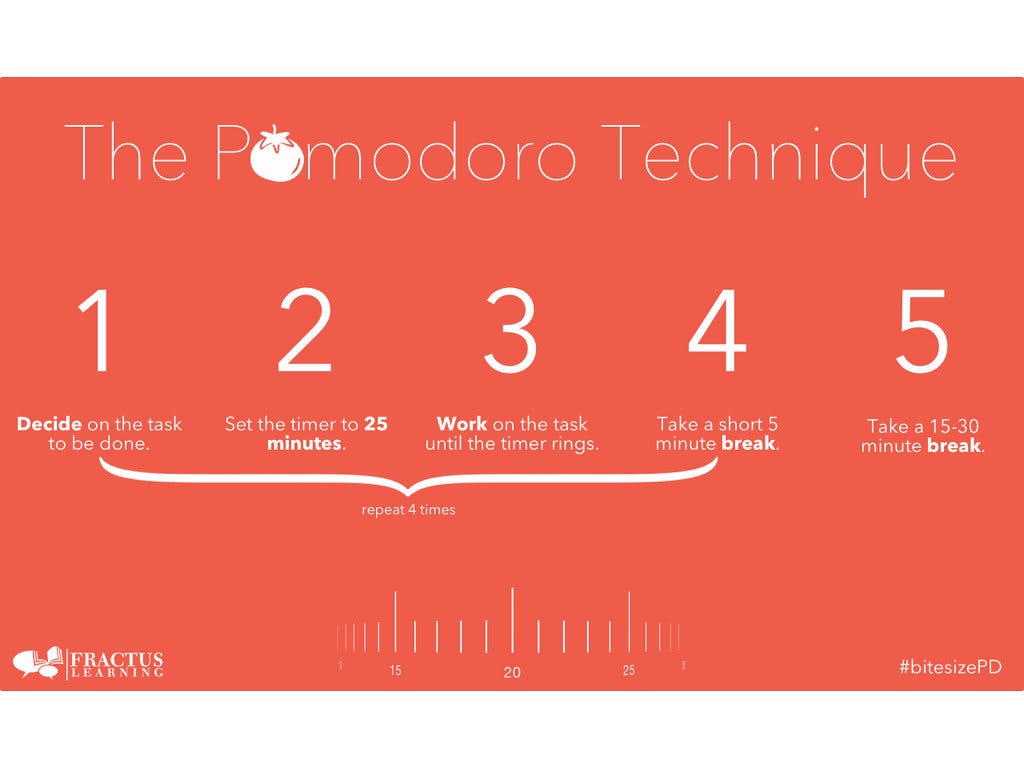
 For this technique, you need to focus on your work for 25 minutes and then you give yourself a reward of anything pleasurable for a couple of minutes. The reward can be watching TV, playing a game or anything that you like. After the reward, you again resume your work and focus on it for the next 25 minutes and then the reward. Repeat this four times then you can take a longer break of 15–20 minutes.

Thursday, April 2, 2020

Continuous testing

https://www.guru99.com/continuous-testing.html
https://www.katalon.com/resources-center/blog/continuous-testing-introduction/

Test early, test often,test eveywhere, automation

Fast delivery
Good Quality

whenever a developer checks the code in the Source Code Server like Jenkins automated set of unit tests are executed in the continuous process. If the tests fail, the build is rejected, and the developer is notified. If the build passes the test, it is deployed to performance, QA servers for exhaustive functional and load tests. The tests are run in parallel. If the tests pass, the software is deployed in production.

The code is continuously developed, delivered, tested and deployed.

For Example, whenever a developer checks the code in the Source Code Server like Jenkins automated set of unit tests are executed in the continuous process. If the tests fail, the build is rejected, and the developer is notified. If the build passes the test, it is deployed to performance, QA servers for exhaustive functional and load tests. The tests are run in parallel. If the tests pass, the software is deployed in production.

Continuous Testing is a small cog in the Continuous Development, Integration and Deployment Cycle


Wednesday, April 1, 2020

Scrum team - Self - organizing

Scrum Teams are self-organizing….. Self-organizing teams choose how best to accomplish their work, rather than being directed by others outside the team.

Self-organisation is a process where some form of global order or coordination arises out of the local interactions between the components of an initially disordered system. This process is spontaneous: it is not directed or controlled by any agent or subsystem inside or outside of the system; however, the laws followed by the process and its initial conditions may have been chosen or caused by an agent.

The key here is that there is no single point of authority, even temporarily, in a self-organizing team. Every individual member of the team volunteers for tasks within the framework of “the laws followed by the process” – namely Scrum. Scrum does define some constraints on individual behaviour, particularly for the Product Owner and the ScrumMaster. People in those two roles have specific duties which usually prevent them from being able to volunteer for any task. But all the other team members (the Development Team) have complete freedom to individually and collectively figure out how they will do the work at hand.

What is open banking

Diagram B1 - Open banking involves the sharing of customer banking data
‘Open banking’ refers to a standardised and secure framework for sharing bank customer data with trusted financial service providers (‘providers’), such as technology companies (see diagram B1). It will enable providers to offer a wide range of new financial services. For example, retail payment mechanisms could be developed to allow restaurant bills to be split and paid automatically using mobile phone applications. Or applications could offer timely and personalised budget advice, for example when a customer enters a shop.

Monday, March 30, 2020

React vs Angular vs Vue

Angular:
Released in 2010 by Google. It is a typescript based javascript framework. It was released prior to the other two Javascript frameworks. Today it is called Angular but before 2016 there was a suffix ‘JS’ to its name. JS was dropped from its name after the release of Angular 2+. On 28 May’2019, its latest version, Angular 8.0.0 was released. 

Google and Wix are among the most popular companies using Angular.

React: - Flexibility
Released in 2013 by Facebook. It is mostly used in high traffic websites. It was developed when Facebook ads started gaining traffic and faced problems in their coding and maintenance which depicted certain issues. Its latest version, 16.8.6 was released on 6 May’2019.
They were resolved with the release of this library of Javascript. Whatsapp, Instagram Paypal, Glassdoor, BBC are some of the popular companies using React. It is highly dynamic and offers great support in creating interactive user interfaces.

Vue: - Open Source Community
A progressive Javascript framework released in 2014 and developed by no big name like React and Angular. In fact, it was created by an ex-engineer of Google, Evan You. It is gaining constant popularity. Its latest version; Version 2.6.10 was released on 20 March 2019.
It is the youngest member of the family of Javascript frameworks. It has
practically removed the drawbacks of the other frameworks to offer ease
of next level to software developers. Websites like GitLab and Alibaba
are using Vue.

Vue and React offers better performance and flexibility than Angular.
Vue and react are more suited for light-weight applications and angular is the best for large UI applications.
Angular is highly opinionated and unlike Vue and React, it offers everything
from routing, templates to testing utilities in its package.
Vue is the most popular, loved and growing framework of Javascript.


API interview questions

  https://www.katalon.com/resources-center/blog/web-api-testing-interview-questions/ Top 50+ Web API Testing Interview Questions [Ultimate l...